
Rytis Prekeris Lab
University of Colorado Anschutz Medical Campus
Molecular Mechanisms Regulating Cell Polarity
My general research interest is to understand the mechanisms of cell polarization and the functional consequences of this polarization during development and cancerogenesis. In the last several years my laboratory has focused on three distinct but related projects: (1) regulation of mitotic cell division (with focus on Abscission Checkpoint in cancer cells), (2) mechanisms of breast cancer cell migration and metastasis, and (3) regulation of primary cilia signaling in renal epithelia, especially during development of polycystic kidney disease. The latest findings and future directions for these projects are described below.
1. The role of midbody-associated RNA during abscission regulation in cancer cells
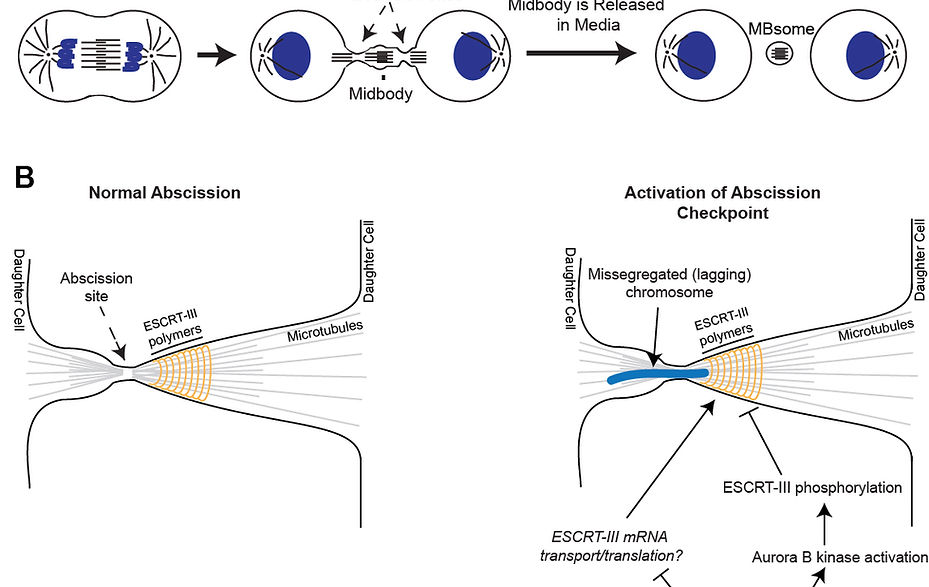
Cytokinesis is the final stage of the cell cycle resulting in physical separation of daughter cells. At late mitosis, the mother cell divides by the formation of a cleavage furrow, leaving two daughter cells connected by a thin intercellular bridge (ICB). The resolution of this bridge, abscission, is mediated by coordinated action between specialized recycling endosomes and cytoskeleton. During ingression of the cleavage furrow, the central spindle microtubules are compacted to form the structure known as the midbody (MB). The MB is situated within the ICB, with the abscission usually occurring at both side of the MB (Fig. 1A). Recently we developed a protocol for purification of MBsomes and completed their proteomic and RNAseq analyses that led to identification of several mRNAs and mRNA-binding proteins that accumulate at the MBs. We also demonstrated that 3’ untranslated regions (3’-UTRs) of these mRNAs are required for their targeting to the MB. Importantly, MB-enriched mRNAs encode several ESCRT-III complex subunits, the complex that is key to abscission. All these all data suggest that mRNA targeting and localized translation at the MB plays a key role in regulating cell division (Fig. 1B). Testing this hypothesis is one of research directions in my lab.
During defects in assembly of the mitotic spindle the chromosomes are not fully separated, leading to the formation of lagging chromosomes. These lagging chromosomes remain trapped within the midbody and intercellular bridge, thus, the completion of the abscission can lead to fragmentation of these lagging chromosomes. This chromosome fragmentation and subsequent reassembly (chromothripsis) is quite common in cancer cells and is one of the leading causes for chromosome instability. Importantly, in normal cells, lagging chromosomes trigger the abscission checkpoint, thus, arresting cells in late telophase to allow for the clearance of the lagging chromosomes. Despite its importance in ensuring the fidelity of chromosome segregation, the abscission checkpoint remains to be poorly understood. Even less is known about why the abscission checkpoint is not activated in some of the rapidly proliferating breast cancer cells. Understanding the machinery governing abscission checkpoint in cancer cells and determining whether RNA targeting and translation is part of the abscission checkpoint is also one of research directions in my lab (Fig. 1B).
2. Regulation breast cancer metastasis.
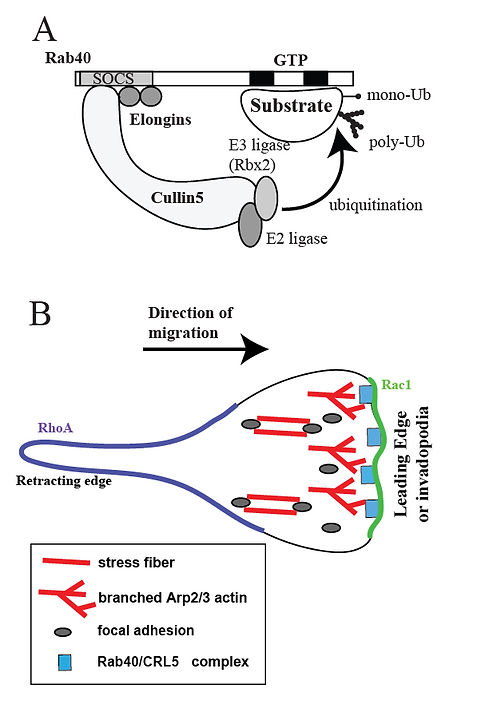
One of the most fundamental challenges in cell biology is understanding how cells migrate during development and cancer metastasis. Thus, one of the research interests in my laboratory is to understand the molecular machinery governing the establishment of front-to-back polarity, as well as regulating actin cytoskeleton and focal adhesion dynamics during breast cell migration (Fig. 2). As part of these studies, we identified Rab40 family of proteins as key regulators of cell migration in vitro and in vivo. Rab40 subfamily is unique because it contains SOCS box located at the C-terminal end of the protein, and we have shown that the Rab40 binds to Cullin5 via the SOCS box to form a ubiquitin E3 ligase complex (Rab40/CRL5) that regulates various aspects of cell migration. We also demonstrated that Rab40/CRL5 complex mediates mono-ubiquitylation of several actin regulators, including Rap2. We also demonstrated that ubiquitylated Rap2 is targeted to the leading from of the migrating cell where it regulates actin dynamics and formation of focal adhesions. Finally, to investigate the roles of Rap2 and Rab40 in regulating cell migration in vivo, we established a collaboration with Dr. Kristin Artinger to study the roles of Rab40 and Rap2 during migration of neural crest cells during zebrafish migration. Currently in my lab we are interested in answering following questions: (1) How Rap2 and Rab40 proteins regulates acting dynamics at the leading edge of migrating breast cancer cell? (2) what function does rab2 play in regulating Neural Crest cell (NCC) migration during zebrafish development/ and (3) What is molecular machinery governing rap2 and Rab40 functions during cell migration?
3. The regulation and function of cilia signaling in renal epithelial cells
Cytokinesis is the final stage of the cell cycle resulting in physical separation of daughter cells. At late mitosis, the mother cell divides by the formation of a cleavage furrow, leaving two daughter cells connected by a thin intercellular bridge (ICB). The resolution of this bridge, abscission, is mediated by coordinated action between specialized recycling endosomes and cytoskeleton. During ingression of the cleavage furrow, the central spindle microtubules are compacted to form the structure known as the midbody (MB). The MB is situated within the ICB, with the abscission usually occurring at one side of the MB. As a result of this one-sided (asymmetric) abscission, only one daughter cell inherits the post-mitotic MB. These post-mitotic MBs can then either accumulate in the cytoplasm or be degraded. Interestingly, recent studies have identified post-mitotic MBs as novel signaling platforms regulating stem cell fate and proliferation. Indeed, stem cells were shown to accumulate post-mitotic MBs and the induction of MB accumulation leads to reprogramming of cell fate and conversion to highly-proliferative stem cell-like phenotypes. Despite the importance of MBs in determining cell fate and proliferative capacity, the mechanisms that regulate asymmetric MB inheritance and post-mitotic degradation remains completely unknown. As the result, the main goal of this project is to identify the factors mediating MB inheritance and accumulation, and to test the role of these factors in regulating stem cell fate and differentiation.